
The conversation around Environmental, Social, and Governance (ESG) has shifted. What was once a corporate afterthought is now one of the most decisive factors in winning business, attracting talent, and building lasting trust. And yet, too many organisations are still treating it as a compliance checkbox rather than a genuine commitment.
At Vantify, we believe that is a problem and one we are determined to avoid. But let us be clear about something before we go any further: beyond the commercial case, beyond the tender requirements and the talent expectations, operating a business ethically is simply the right thing to do. The planet is fragile. Our people and our clients are valuable. That alone is reason enough. This is where we stand, what we are doing, and why it matters.
Why ESG Matters More Than Ever
Before we get into what we are doing, it is worth being honest about why it matters. Because the consequences of getting ESG wrong are not abstract. They show up in lost tenders, high staff turnover, and clients who quietly move on.
By law, UK central government contracts must score suppliers on social value – their environmental impact, ethical practices, and community contribution, and that score must account for at least 10% of the total evaluation. Some authorities are already weighting it higher. That means a supplier with the sharpest price can still lose a contract if their ESG response does not stack up. 78% of procurement professionals say ESG is considered important within their organisation, and weak ESG responses are cutting businesses from shortlists before price is even discussed.
For clients in property management, retail and hospitality, the pressure does not stop at their own front door. Their investors, customers and regulators are pulling ESG transparency up through the supply chain. Almost half of all organisations have already received requests for carbon data from clients or as part of tender applications. That means when a property management firm signs with Vantify, our ESG credentials become part of their story. A hospitality group reporting against net zero targets cannot afford suppliers who cannot account for their own impact. A retailer facing scrutiny over modern slavery needs partners with verified governance standards, not good intentions. We are accountable to our clients’ ESG position, not just our own.
The gap between what buyers are expecting and what suppliers can evidence is widening, and for businesses without verifiable ESG commitments, that gap is becoming a serious commercial liability.
But it’s not just about contracts, the people you want to hire are paying attention too. In fact, 43% of 18 to 34 year olds say they would leave their employer if its ESG values did not align with their own. With Millennials and Gen Z making up the majority of the workforce, this is not a fringe concern. The businesses that will attract the best people are the ones that can back their values with evidence.
Beyond tenders, the risks of underinvesting in ESG are real and compounding: reduced ability to attract talent, weaker retention, reputational exposure, and growing regulatory scrutiny. The businesses that treat ESG as a future problem will find it becomes a present one faster than they expect.
The message is simple: ESG is a commercial and operational reality. The question is whether your position is evidenced well enough to hold up when it counts. But the deeper question for any business serious about its place in the world, is whether it is being done because it is required, or because it is right.
Vantify and Axiom GRC: Part of Something Bigger
Vantify is part of Axiom GRC, a business that has placed responsibility at the heart of its operations. Axiom’s Group-level commitments include a target to cut emissions by 50% by 2032, with a pathway to become a net zero business before 2050. These targets are science-based and aligned with the Paris Agreement, and they are supported by a Net Zero Transition Plan that is actively transforming how the Group manages offices, travel, and supply chain carbon intensity.
As part of the Axiom family, we share those ambitions. But we also have our own ESG Policy, our own initiatives, and our own accountability. That matters to us. Shared goals do not mean shared responsibility is diluted, it means we’re contributing to something meaningful at scale, while taking ownership of our specific impact as Vantify.
What We’re Actually Doing
On the Environment
Our ISO 14001 and ISO 45001 certifications, both achieved in 2023, give us a structured framework for managing our environmental impact and occupational health and safety. These aren’t just badges on a wall. They represent a commitment to continuous improvement backed by an independent audit process.
 We’re actively reducing transport emissions across our operations with our consultants regionally scheduled to minimise unnecessary travel. We are also developing a KPI framework to measure miles per job, so we can track progress with data, not just intent. Multiple team members have already signed up to our Electric Vehicle salary sacrifice scheme, which launched at the end of February 2026, using second-hand EVs to further reduce our carbon footprint. The scheme includes access to second-hand EVs, reducing the carbon cost of the vehicles themselves, not just the fuel.
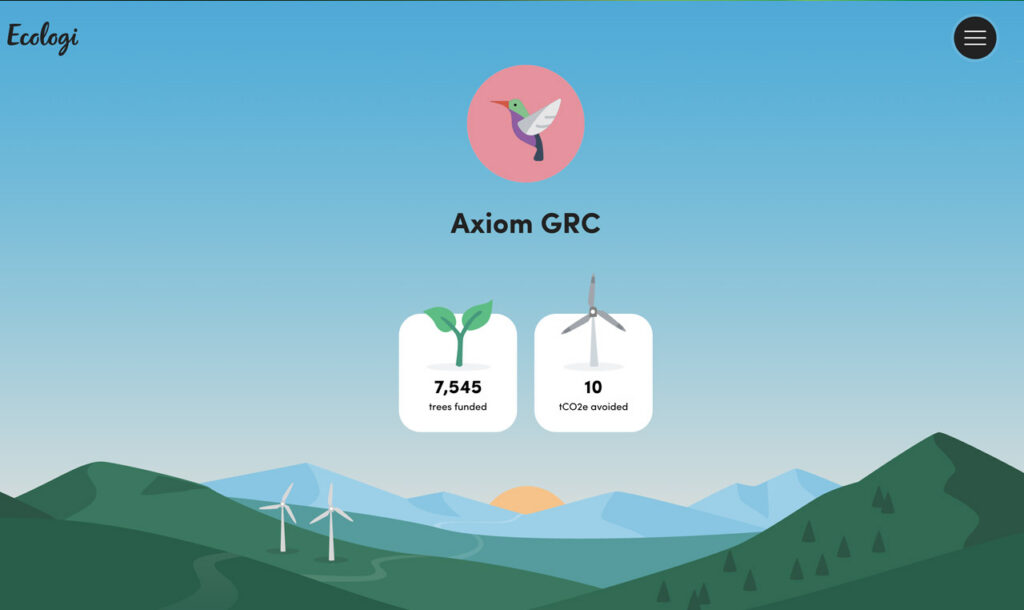
Vantify were the first to partner with Ecologi, planting over 1,500 trees and setting the standard for the wider group. Through that initiative, Axiom’s partnership with Ecologi has now grown to over 7,500 trees planted, a contribution to biodiversity protection that reflects a shared commitment to nature-based solutions alongside direct emissions reduction. Protecting biodiversity is an integral part of any credible net zero transition, not an optional add-on.
On our People
Last year, we ran a dedicated ESG Awareness Week, covering a different topic each day across five days. This was a business-wide educational initiative, not just a leadership exercise, because genuine ESG culture starts with informed people at every level, not just the leadership team. From environmental issues to social responsibility and governance, the week was designed to spark conversations that continue well beyond it.
Every employee completes mandatory ESG training through our eLearning provision, including modules on modern slavery and whistleblowing. This helps to build a culture where people understand the issues, recognise the risks, and feel empowered to raise concerns. Our ESG training is aligned to the same standards we help our customers meet through the Vantify Ecosystem, which means we’re not asking others to do what we haven’t already done ourselves.
Across Vantify, our people give their time to causes that matter to them. This year, we are proud to be actively supporting two charities: Mind, doing vital work in mental health, and the British Red Cross, supporting humanitarian efforts at home and abroad. We build paid volunteering days into how we operate and we actively create opportunities for our teams to use them.
Some of our colleagues recently participated in a charity event for Mind, an organisation doing vital work in mental health, and teams have given time and energy to local causes in the communities where they live and work. We build paid volunteering time into how we operate, because showing up for your community shouldn’t have to happen on personal time.
On Governance
Our ESG risks and opportunities are reviewed regularly at ExCo and OpCo level. That oversight matters, because it means ESG does not get parked with a single team and revisited once a year. It sits at the table where business decisions are actually made.
We have a Code of Conduct built on transparency, integrity, and legal compliance. Our internal policies on anti-discrimination, human rights, data protection, cyber security, and modern slavery are consistently maintained, communicated, and upheld across the business.
Responsibility does not stop at the leadership team either. Our ESG Policy applies to all employees, contractors, and suppliers. Line managers are accountable for their teams, and every individual has a personal obligation to understand and uphold these standards. That accountability runs from board level to day one of employment. There is no tier of the organisation where ESG is someone else’s problem.
Looking to the Future
Looking ahead, the businesses that will lead over the next decade are those embedding ESG into their foundations today, not scrambling to retrofit it in response to tenders or regulation. At Vantify, we do not see this as a risk to manage, but as an opportunity to invest in and shape – one that will define long-term value, resilience, and relevance.